
Passionate or Empty Love?
Learn about Sternberg's Theory of Love and which types of love exist

Dear mental health advocate,
For many of us, love is a beautiful, excruciating, mesmerizing and sometimes painful fact of life. It is the thing that keeps many people going or even chase until they have it in some form. While there is much to say and write about self-love, in today’s free article of The Present Psychologist Paper I want to discuss what kind of love can exist between you and a partner if there has ever been romantic intent. There’s tons to say about love, the forms it has and how we express it. Want to know more? Keep on reading!

Eight Types of Love
Have you ever been in love? Are you currently in a relationship? Or are you maybe single? Chances are you might be interested to learn about a fascinating theory about different love styles. Psychologist Robert Sternberg (1986) developed a model in which he discusses how love can differ in relationships and is dependent on the existence of three particular components. It is possible that no component is present, or any combination of the three, two or just one.
Most people think of love as one single feeling. We either love someone or we do not. But psychology suggests that love is much more complex than that! Think about the people you have cared about throughout your whole life. The way you loved your high school crush was probably very different from the way you love the person you’ve been with for 10 years, maybe a spouse, or even a close friend. Yet we often use the same word ‘love’ to describe all of these experiences.
This is one reason Sternberg’s theory remains so popular. It recognizes that relationships can feel very different while still containing genuine affection and attachment. In fact, many couples experience several of these types of love throughout the course of a single relationship. So here are the three components explained:
Intimacy. This is the component of love that includes to what extent the romantic partners feel close to each other. It is about feeling connected and bonded and experiencing feelings of warmth together. This part is more important in long-term relationships and less in short-term ones.
Passion. This component of love talks about the physical and romantic attraction partners feel about each other. It is about the arousal and sexual pleasure that is experienced together. Thus part plays a bigger role in short-term relationships and more medium in long-term relationships.
Decision/commitment. This component of love is about the decision or commitment someone makes to be with someone and do their best to keep that relationship going. It is as much about a cognitive commitment as an emotional one. In short-term relationships it hardly plays a part, but in long-term ones very much so.
If you are in a relationship it is possible that the type of love changes. There are stages and all combinations can occur in someone’s life. According to Sternberg, the strongest form of love happens when all three of these components are present. But, dependent on what people find important other types can work as well. It must be said that Sternberg believed if only one component is present, the relationship can become a bit unbalanced. Still, do not just label your relationship. There are highs and lows, relationships go through phases and what we need might be different from others.
An easy way to think about these three components is to imagine a campfire. Intimacy is the warmth you feel when sitting close together. Passion is the flame itself: super intense and quite difficult to ignore. Commitment is the person who keeps adding wood to the fire so it does not go out. A strong and lasting relationship often needs all three. If one element is missing, the fire may still burn, but it might not be as stable or satisfying as you’d want.
Interestingly, the importance of these components often changes over time. In the beginning of a relationship, passion tends to take center stage. Couples may think about each other constantly and feel strong excitement when they are together. As the years pass, intimacy and commitment often become increasingly important. Research consistently shows that couples who maintain emotional closeness and commitment tend to report greater relationship satisfaction over the long term.
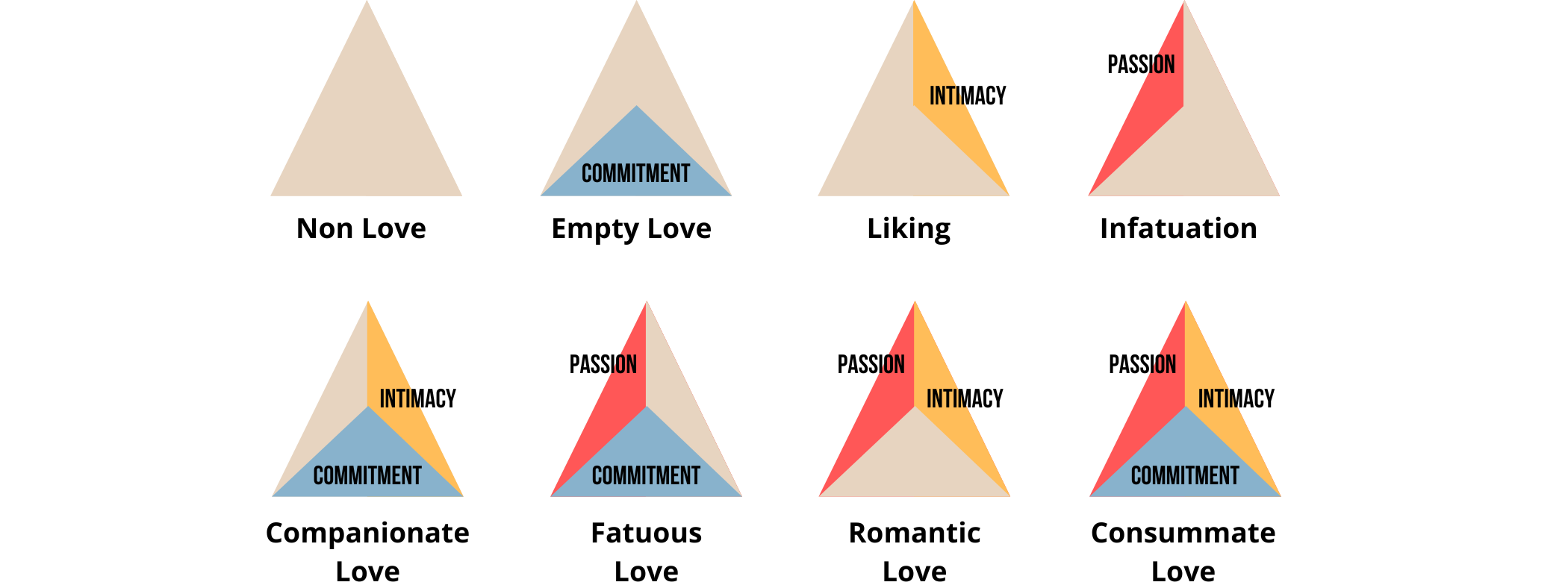
As these three combine in different forms of love, Sternberg gave them names to help explain what each type looks like. One of the most fascinating aspects of Sternberg’s theory is that none of these categories should be viewed as simply permanent labels. Relationships are highly dynamic. A couple may start with infatuation, develop romantic love, and eventually move toward consummate love. Likewise, a relationship that once felt perfect can lose one or more components over time.
Imagine a relationship as a journey rather than a destination. At different moments, different forms of love may emerge depending on the life circumstances people face. Stress, children, career demands, illness, or simply the passage of time can all affect intimacy, passion, and commitment.
Non-love. The first type of love is actually a form where not a lot of deep love is present, as none of the three components apply. Sternberg argues this occurs in more casual encounters and is true for many personal, non-romantic relationships. Think about a cashier at the supermarket or a neighbor you occasionally greet.
Liking. If passion and commitment is not present, but intimacy is then Sternberg called the form of love ‘liking’. This means that there is a bond, a closeness and warmth between people but nothing more. These apply to friendships often. While there is no romantic attraction and no intention to build a romantic future together, some people actually describe their best friend as their ‘soulmate,’ illustrating how powerful intimacy can be even without passion.
Infatuation. If only passion is present, then we could speak of infatuation. It means there is a physical or romantic attraction to someone, but nothing else. No commitment, no intimacy. Love-at-first-sight can be seen as this type of love. Most people can probably remember at least one infatuation from their teenage years. Perhaps you saw someone across a room and immediately felt attracted to them. You find yourself constantly thinking about that person despite knowing very little about who they actually are. Psychologists sometimes refer to this period as seeing someone through ‘rose-colored glasses,’ where attraction can temporarily overshadow reality.
Empty love. It is possible that there only is decision/commitment, but no passion or intimacy. In that case there are not a lot of romantic feelings involved, but still there is a strong urge to make the relationship last. At first glance this form of love sounds negative, but that is not always the case. In some cultures, arranged marriages may begin primarily with commitment. Intimacy and passion can develop later. In other situations, empty love may occur when couples stay together because of shared responsibilities, financial reasons, or family obligations despite the disappearance of emotional and physical connection
Romantic love. If a couple feels passion and love for each other and shares intimacy, then it is likely to be a romantic relationship. But, in this case no decision or commitment is made (yet). Often this happens in the dating/beginning phase. Romantic love is basically what many of the movies and songs are built around. Two people feel emotionally connected and physically attracted to each other. They enjoy long conversations and often experience a sense of emotional closeness. However, because commitment is not yet firmly established, the future of the relationship may still be uncertain.
Companionate love. When two people share commitment and intimacy, but passion has disappeared, then the relationship is seen as more companionate love. It is seen often in long-term committed relationship where physical attraction is not really present anymore. Companionate love is often underestimated. Society tends to celebrate passion, but many psychologists view companionship as one of the most valuable foundations for long-term happiness. Couples experiencing companionate love often describe each other as best friends. They share trust and deep understanding.
Fatuous love. If there is commitment and passion, but no intimacy. These are the more whirlwind relationships which can be short and intense, when people quickly commit but there is no real closeness or bond yet. Celebrity marriages that happen after a very short courtship are sometimes looked at as examples of fatuous love. The passion is intense and commitment arises quickly, but genuine intimacy takes time to develop. Couples may feel certain they have found “the one” before they truly know each other’s values, habits, strengths, and weaknesses.
Consummate love. The type of love where all three components are present is seen as the highest and strongest form of love. Consummate love combines emotional closeness, attraction, and commitment. Partners enjoy being together, feel physically connected, and choose each other repeatedly over time. Sternberg considered this the most complete form of love. However, he also emphasized that achieving consummate love is easier than maintaining it. Like a garden, relationships require ongoing effort if they are to flourish.
So, what to do?
Well… maybe the most important lesson you and I can take from Sternberg’s theory is that love is not simply something that happens to us. Love is also something that has to be nurtured. While passion may sometimes just exist spontaneously, intimacy grows through being vulnerable and sharing experiences. Commitment develops in the end by doing the hard work and through the choices we make every day.
Rather than asking whether your relationship fits perfectly into one category, it may be more useful to ask yourself three questions: Do we feel close to each other? Do we still experience attraction? And are we committed to maintaining the relationship? These answers can provide valuable insights into the strengths of a relationship and the areas that may need more attention between the two of you.
After all, love is rarely static. It can change, disappear and sometimes grows stronger than ever. Sternberg’s theory reminds us that there is not just one way to love. If you understand the different forms of love then it can definitely help you to better understand yourself and the relationships that matter most.
Premium content 📂
Whether you are new to The Present Psychologist Paper or not, I’d like to let you know that on this platform I send out editions with articles about psychology and mental health every month. I send out a free version, but also a paid version. The free one consists of one article, the paid one means getting extra articles sent. It’s the price of a cheap takeaway coffee each month, cancellable when you want and you would support me as a freelancer.